Introduction: A Drug Class That Refused to Stay in One Box
Phosphodiesterase type 5 inhibitors (PDE-5 inhibitors) represent one of the rare success stories in pharmacology where a drug class transcended its original purpose and reshaped multiple fields of medicine. Initially introduced for erectile dysfunction (ED), these agents—most notably sildenafil—have steadily expanded their clinical relevance into cardiovascular and pulmonary medicine.
The foundation of their success lies in a deceptively simple mechanism: modulation of cyclic guanosine monophosphate (cGMP). Yet, behind this biochemical simplicity stands a profound influence on vascular tone, endothelial function, and cellular signaling. Today, PDE-5 inhibitors are not merely symptomatic treatments—they are modulators of vascular biology.
The materials you provided reveal two complementary perspectives. One focuses on patient-centered innovation in ED therapy, emphasizing adherence, satisfaction, and novel formulations . The other explores the molecular and hemodynamic effects of sildenafil in acute pulmonary embolism (APE), highlighting its role beyond sexual medicine . When these perspectives are integrated, a broader and more compelling narrative emerges: sildenafil is not just a drug—it is a platform for vascular modulation.
The NO–cGMP Axis: A Master Regulator of Vascular Function
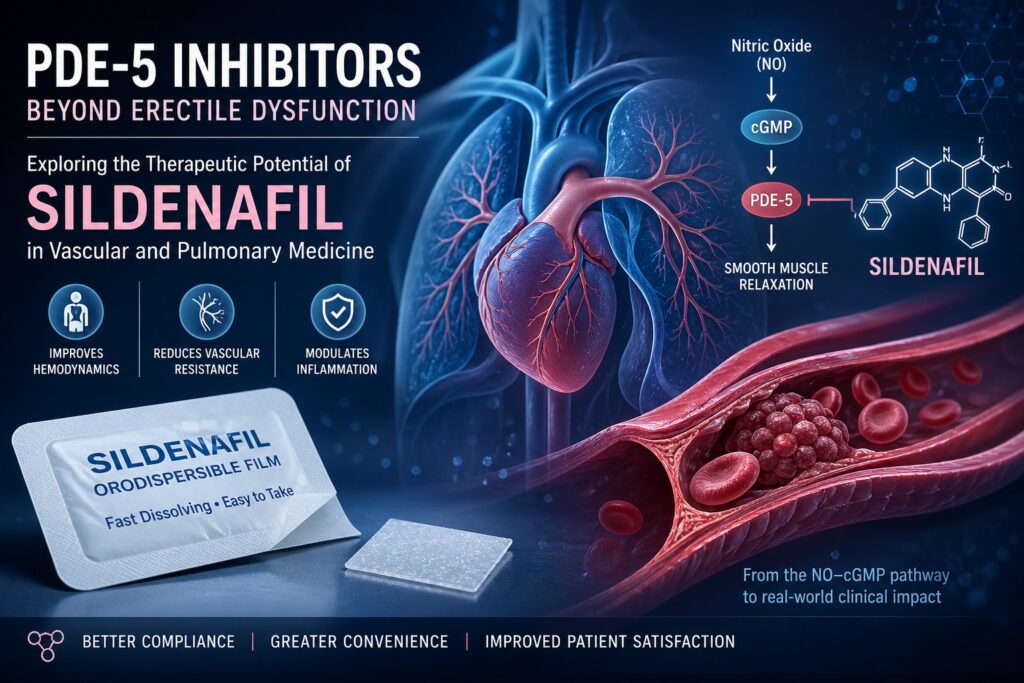
At the core of PDE-5 inhibitor pharmacology lies the nitric oxide (NO)–cGMP signaling pathway. This pathway governs smooth muscle relaxation across multiple organ systems, including the penile corpora cavernosa and pulmonary vasculature. Nitric oxide stimulates guanylate cyclase, increasing intracellular cGMP levels, which in turn reduce calcium concentrations and promote smooth muscle relaxation.
In erectile physiology, this translates into increased arterial inflow and restricted venous outflow, allowing penile erection. However, this same pathway operates in pulmonary arteries, where it regulates vascular tone and resistance. PDE-5, the enzyme targeted by sildenafil, degrades cGMP. By inhibiting this enzyme, sildenafil effectively prolongs and amplifies vasodilatory signaling.
The review article emphasizes that PDE-5 is highly expressed in smooth muscle tissues, particularly within the corpora cavernosa, making it a logical therapeutic target in ED . However, its expression in pulmonary arterial smooth muscle cells explains why sildenafil has demonstrated efficacy in pulmonary hypertension and related disorders.
This dual relevance is not coincidental. It reflects a shared physiological architecture: vascular beds, whether penile or pulmonary, rely on tightly regulated smooth muscle tone. Sildenafil intervenes precisely at this regulatory node, offering both local and systemic benefits.
Sildenafil: Pharmacological Profile and Clinical Versatility
Sildenafil was the first PDE-5 inhibitor introduced into clinical practice and remains the most extensively studied. Its pharmacokinetic profile—relatively rapid absorption and a moderate half-life—makes it suitable for both on-demand and, in some contexts, continuous therapeutic use.
Clinical data consistently demonstrate its efficacy. Approximately 80% of men with ED experience improved erectile function with sildenafil compared to roughly 25% on placebo . Importantly, its effectiveness is largely independent of age, disease severity, or underlying etiology, which explains its widespread adoption.
Yet, the clinical importance of sildenafil extends far beyond efficacy. It has a well-characterized safety profile, with adverse effects such as headache and flushing generally mild and transient. This predictable tolerability has contributed significantly to its long-term success.
Interestingly, sildenafil’s pharmacological reach continues to expand. Experimental evidence demonstrates its ability to improve pulmonary hemodynamics, reduce inflammatory signaling, and inhibit maladaptive vascular remodeling . These findings suggest that sildenafil may be better understood as a systemic vascular modulator rather than a condition-specific drug.
Patient-Centered Medicine: Why Efficacy Alone Is Not Enough
One of the most striking insights from the ED-focused review is that pharmacological efficacy does not guarantee patient adherence. Despite the proven effectiveness of PDE-5 inhibitors, up to 50% of patients discontinue therapy within one year . This paradox reveals a critical truth: successful treatment must align with patient expectations, not just physiological outcomes.
The reasons for discontinuation are multifactorial. They include psychological barriers, relationship dynamics, concerns about spontaneity, and dissatisfaction with the mode of drug administration. Even when erectile function improves, patients may abandon therapy if it disrupts the natural flow of intimacy or feels overly medicalized.
Key expectations identified among patients include:
- Rapid onset of action and sufficient duration for intercourse
- Preservation of spontaneity and naturalness
- Discreet and convenient administration
- Minimal side effects and psychological burden
These factors highlight the importance of integrating pharmacology with human behavior. A drug that works in theory but fails in real life is, clinically speaking, only partially effective.
Innovative Drug Delivery: The Rise of Orodispersible Sildenafil
To address these unmet needs, pharmaceutical innovation has shifted toward alternative drug delivery systems. Among the most notable developments is the orodispersible film (ODF) formulation of sildenafil.
Unlike conventional tablets, ODFs dissolve rapidly in the mouth without the need for water. This seemingly minor modification has significant implications. It enhances discretion, simplifies administration, and aligns better with the spontaneous nature of sexual activity.
From a pharmacokinetic standpoint, sildenafil ODF is bioequivalent to traditional film-coated tablets, meaning it delivers comparable systemic exposure and therapeutic effect . The difference lies not in efficacy, but in user experience.
Advantages of ODF formulations include:
- Rapid disintegration and ease of use
- Improved patient compliance and satisfaction
- Reduced stigma associated with visible medication intake
- Flexible dosing options, including intermediate strengths
This innovation reflects a broader trend in medicine: the recognition that drug delivery is as important as drug action. A therapy that integrates seamlessly into a patient’s life is far more likely to succeed.
Beyond Sexual Medicine: Sildenafil in Pulmonary Vascular Disease
While patient-centered innovations dominate the ED landscape, the second study introduces a more mechanistic and translational dimension. It examines sildenafil in the context of acute pulmonary embolism, a condition characterized by sudden increases in pulmonary vascular resistance and right ventricular strain.
In this model, sildenafil significantly reduced right ventricular systolic pressure (RVSP) and mean pulmonary arterial pressure (MPAP), indicating improved hemodynamic stability . Histological analysis further revealed reduced inflammation and preservation of lung tissue architecture.
These findings are particularly important because they demonstrate that sildenafil does not merely dilate blood vessels—it modifies disease progression. By attenuating inflammatory responses and improving endothelial function, it addresses both symptoms and underlying pathology.
This dual action positions sildenafil as a candidate for broader therapeutic applications, particularly in conditions where vascular dysfunction plays a central role.
Rho Kinase and Molecular Crosstalk: A Deeper Mechanistic Insight
A key mechanistic insight from the pulmonary study is the interaction between sildenafil and the RhoA/Rho kinase (ROCK) pathway. This pathway is a critical regulator of smooth muscle contraction and is often overactivated in pathological states such as pulmonary hypertension.
Activation of ROCK leads to increased phosphorylation of myosin light chains, enhancing vascular contraction and resistance. In acute pulmonary embolism, this contributes significantly to hemodynamic deterioration.
Sildenafil appears to counteract this process indirectly. By enhancing NO–cGMP signaling, it suppresses ROCK activation, reducing vasoconstriction and improving blood flow. When combined with a direct ROCK inhibitor, the effects are even more pronounced, suggesting a synergistic relationship .
This interaction highlights an important principle: modern pharmacology increasingly involves pathway modulation rather than single-target intervention. Sildenafil exemplifies this approach, influencing multiple signaling networks simultaneously.
Clinical Perspective: Integrating Mechanism, Experience, and Outcome
From a clinical standpoint, the true value of sildenafil lies in its versatility. It bridges the gap between molecular pharmacology and patient-centered care. Few drugs manage to operate effectively at both levels.
In erectile dysfunction, it restores physiological function while adapting to patient expectations through innovative formulations. In pulmonary disease, it stabilizes hemodynamics and modulates pathological signaling pathways.
This dual role underscores the importance of a holistic approach to treatment. Physicians must consider not only the biological mechanisms of disease but also the lived experience of the patient. Sildenafil, in many ways, embodies this balance.
Future therapeutic strategies will likely build on this model, combining pharmacological precision with personalized delivery systems and patient engagement.
Conclusion: Sildenafil as a Model of Modern Pharmacotherapy
Sildenafil has evolved from a targeted therapy for erectile dysfunction into a cornerstone of vascular pharmacology. Its ability to modulate the NO–cGMP pathway, inhibit maladaptive signaling such as ROCK activation, and adapt to patient needs through innovative formulations makes it uniquely versatile.
The integration of mechanistic insight and patient-centered design represents the future of medicine. Sildenafil is not merely part of this future—it helped define it.
As research continues, PDE-5 inhibitors will likely expand their role even further, challenging traditional boundaries and offering new therapeutic possibilities across multiple domains of medicine.
FAQ: Practical Questions About PDE-5 Inhibitors and Sildenafil
1. Why are PDE-5 inhibitors considered first-line therapy for erectile dysfunction?
Because they combine high efficacy, predictable safety, and ease of oral administration. Clinical data show significant improvement in erectile function in the majority of patients.
2. How does sildenafil work at the molecular level?
It inhibits PDE-5, preventing the breakdown of cGMP. This enhances nitric oxide signaling, leading to smooth muscle relaxation and improved blood flow.
3. What advantages do orodispersible sildenafil formulations offer?
They dissolve in the mouth without water, improving convenience, discretion, and patient adherence while maintaining equivalent efficacy.
4. Can sildenafil be used outside of erectile dysfunction?
Yes. It is already used in pulmonary hypertension and shows promise in conditions like acute pulmonary embolism due to its effects on vascular tone and inflammation.